
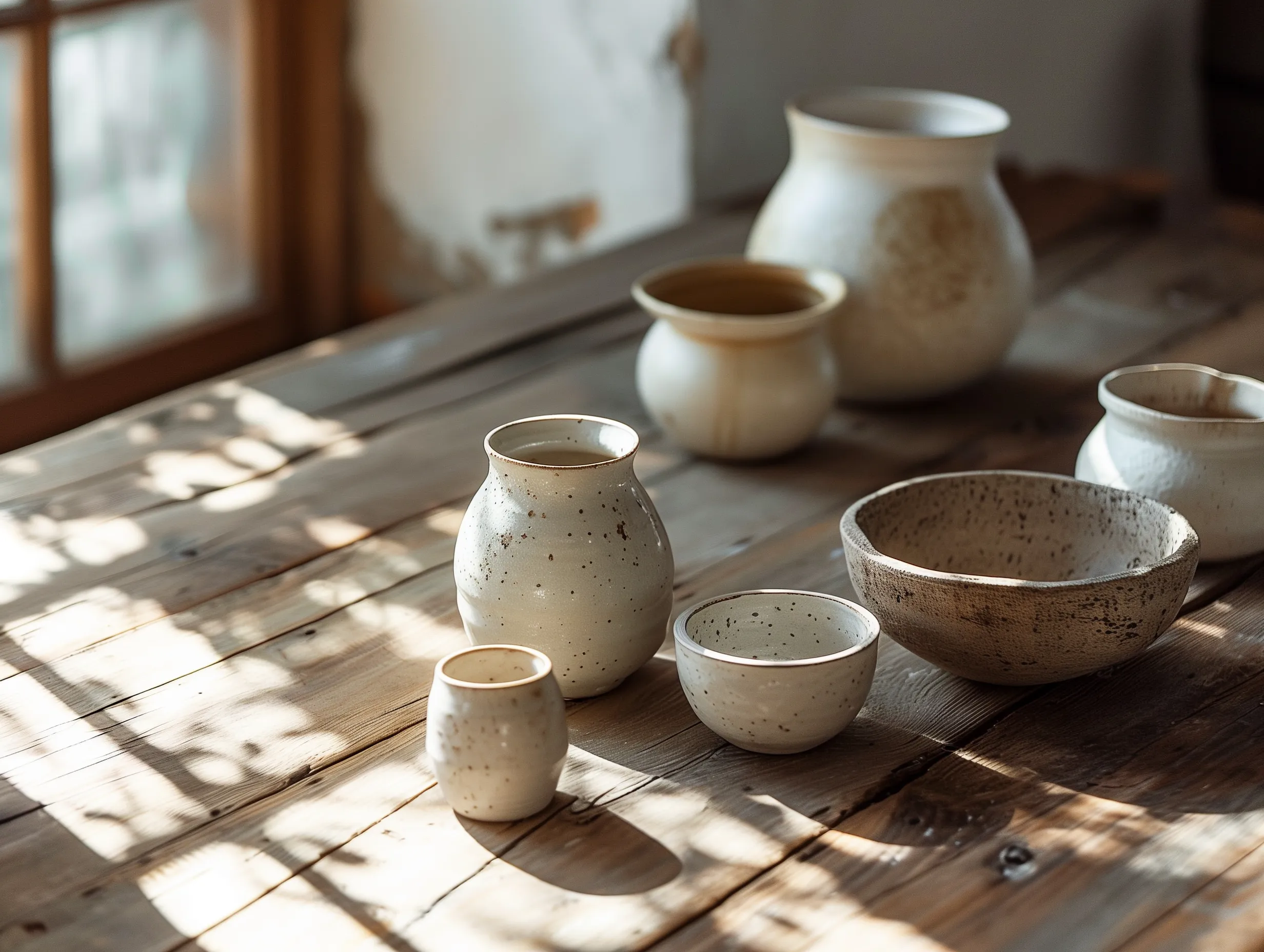
Light is the first collaborator in the studio. It enters without effort, shifting across the wooden floor and clay surfaces as the day unfolds. In the Highlands, light has its own character — sometimes sharp and silvered, other times soft as fog. It defines everything the hands make, moving gently over edges, pooling in texture, and finding life in shadow.
Clay, on its own, is humble. It carries the dull tone of the earth before firing, a raw surface waiting for transformation. But under light, even the simplest form speaks. A curve becomes a landscape; a faint ridge becomes a horizon line. When the glaze catches the sun, it breathes — colours deepen, textures bloom, and imperfections turn into quiet points of beauty.
In the Fàilte studio, light is part of the process. Morning brings the clarity of cool air and pale tones; afternoon fills the space with gold. Each piece is shaped and viewed within these shifts, allowing the environment to inform the final outcome. Sometimes a glaze will change its hue depending on the hour — grey becoming blue, white revealing a hidden warmth. Nothing is fixed; everything exists in transition.
This relationship between clay and light is also a meditation on perception. To see a vessel clearly is to notice the small things: the way a matte surface absorbs light instead of reflecting it, or how a faint line in the glaze reveals the path of a brushstroke. The longer one looks, the more alive the object becomes.
When a finished piece leaves the studio, it carries that dialogue within it. Placed in a new home, it continues to shift and respond — to morning light through a kitchen window, or the soft glow of evening beside a candle. Light becomes memory; clay becomes continuity.
Fàilte’s ceramics are not designed for display alone, but for interaction. The more they are used, the more light they gather — in reflections, stains, and the faint polish that comes from touch over time. Each piece grows more itself, more real, more human.
Clay gives form; light gives life. Together, they turn silence into presence — an object into a moment of seeing.
Light is the first collaborator in the studio. It enters without effort, shifting across the wooden floor and clay surfaces as the day unfolds. In the Highlands, light has its own character — sometimes sharp and silvered, other times soft as fog. It defines everything the hands make, moving gently over edges, pooling in texture, and finding life in shadow.
Clay, on its own, is humble. It carries the dull tone of the earth before firing, a raw surface waiting for transformation. But under light, even the simplest form speaks. A curve becomes a landscape; a faint ridge becomes a horizon line. When the glaze catches the sun, it breathes — colours deepen, textures bloom, and imperfections turn into quiet points of beauty.
In the Fàilte studio, light is part of the process. Morning brings the clarity of cool air and pale tones; afternoon fills the space with gold. Each piece is shaped and viewed within these shifts, allowing the environment to inform the final outcome. Sometimes a glaze will change its hue depending on the hour — grey becoming blue, white revealing a hidden warmth. Nothing is fixed; everything exists in transition.
This relationship between clay and light is also a meditation on perception. To see a vessel clearly is to notice the small things: the way a matte surface absorbs light instead of reflecting it, or how a faint line in the glaze reveals the path of a brushstroke. The longer one looks, the more alive the object becomes.
When a finished piece leaves the studio, it carries that dialogue within it. Placed in a new home, it continues to shift and respond — to morning light through a kitchen window, or the soft glow of evening beside a candle. Light becomes memory; clay becomes continuity.
Fàilte’s ceramics are not designed for display alone, but for interaction. The more they are used, the more light they gather — in reflections, stains, and the faint polish that comes from touch over time. Each piece grows more itself, more real, more human.
Clay gives form; light gives life. Together, they turn silence into presence — an object into a moment of seeing.
Light is the first collaborator in the studio. It enters without effort, shifting across the wooden floor and clay surfaces as the day unfolds. In the Highlands, light has its own character — sometimes sharp and silvered, other times soft as fog. It defines everything the hands make, moving gently over edges, pooling in texture, and finding life in shadow.
Clay, on its own, is humble. It carries the dull tone of the earth before firing, a raw surface waiting for transformation. But under light, even the simplest form speaks. A curve becomes a landscape; a faint ridge becomes a horizon line. When the glaze catches the sun, it breathes — colours deepen, textures bloom, and imperfections turn into quiet points of beauty.
In the Fàilte studio, light is part of the process. Morning brings the clarity of cool air and pale tones; afternoon fills the space with gold. Each piece is shaped and viewed within these shifts, allowing the environment to inform the final outcome. Sometimes a glaze will change its hue depending on the hour — grey becoming blue, white revealing a hidden warmth. Nothing is fixed; everything exists in transition.
This relationship between clay and light is also a meditation on perception. To see a vessel clearly is to notice the small things: the way a matte surface absorbs light instead of reflecting it, or how a faint line in the glaze reveals the path of a brushstroke. The longer one looks, the more alive the object becomes.
When a finished piece leaves the studio, it carries that dialogue within it. Placed in a new home, it continues to shift and respond — to morning light through a kitchen window, or the soft glow of evening beside a candle. Light becomes memory; clay becomes continuity.
Fàilte’s ceramics are not designed for display alone, but for interaction. The more they are used, the more light they gather — in reflections, stains, and the faint polish that comes from touch over time. Each piece grows more itself, more real, more human.
Clay gives form; light gives life. Together, they turn silence into presence — an object into a moment of seeing.