
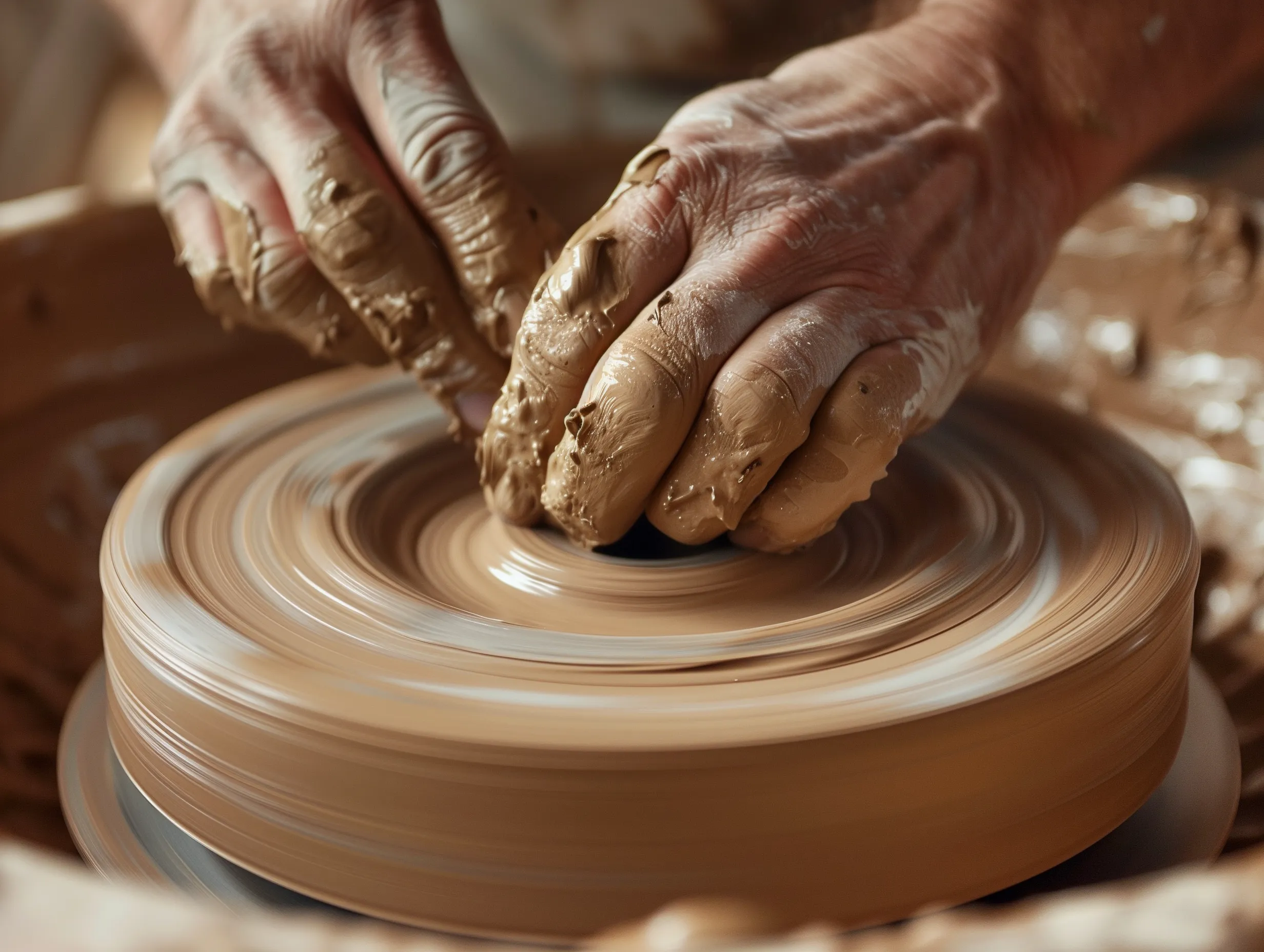
Every piece that leaves the Fàilte studio carries traces of the hand — a soft indentation, a faint unevenness in the rim, the subtle rhythm left by the wheel. These marks are not mistakes. They are signatures — the quiet record of a moment, a gesture, a breath.
In the world of mass production, the hand has almost disappeared. Machines polish, measure, and perfect; surfaces are made to be identical. But within that sameness, something essential is lost — the warmth of intention, the honesty of time. In the studio, each vessel tells a story not of precision, but of presence.
The process is simple but deliberate. The wheel turns slowly, clay responding to touch and pressure. Fingers guide, shape, and release — never in exactly the same way twice. Even the glaze, when poured or brushed, takes its own path; it gathers differently around every curve, forming subtle variations of tone and depth.
To leave these traces visible is an act of respect — to the material, to the maker, and to the person who will one day hold the finished piece. When the cup is lifted, the hand of the maker meets the hand of the user; two gestures separated by time but joined in experience.
These moments of contact define the work. They remind us that the object is alive in its imperfection — that beauty does not come from control, but from surrender.
At Fàilte, each vessel becomes a quiet collaboration between clay, hand, and fire. No line is repeated. No surface is truly smooth. And in those irregularities lies its truth: a human rhythm, steady and imperfect, that endures long after the wheel has stopped.
Every piece that leaves the Fàilte studio carries traces of the hand — a soft indentation, a faint unevenness in the rim, the subtle rhythm left by the wheel. These marks are not mistakes. They are signatures — the quiet record of a moment, a gesture, a breath.
In the world of mass production, the hand has almost disappeared. Machines polish, measure, and perfect; surfaces are made to be identical. But within that sameness, something essential is lost — the warmth of intention, the honesty of time. In the studio, each vessel tells a story not of precision, but of presence.
The process is simple but deliberate. The wheel turns slowly, clay responding to touch and pressure. Fingers guide, shape, and release — never in exactly the same way twice. Even the glaze, when poured or brushed, takes its own path; it gathers differently around every curve, forming subtle variations of tone and depth.
To leave these traces visible is an act of respect — to the material, to the maker, and to the person who will one day hold the finished piece. When the cup is lifted, the hand of the maker meets the hand of the user; two gestures separated by time but joined in experience.
These moments of contact define the work. They remind us that the object is alive in its imperfection — that beauty does not come from control, but from surrender.
At Fàilte, each vessel becomes a quiet collaboration between clay, hand, and fire. No line is repeated. No surface is truly smooth. And in those irregularities lies its truth: a human rhythm, steady and imperfect, that endures long after the wheel has stopped.
Every piece that leaves the Fàilte studio carries traces of the hand — a soft indentation, a faint unevenness in the rim, the subtle rhythm left by the wheel. These marks are not mistakes. They are signatures — the quiet record of a moment, a gesture, a breath.
In the world of mass production, the hand has almost disappeared. Machines polish, measure, and perfect; surfaces are made to be identical. But within that sameness, something essential is lost — the warmth of intention, the honesty of time. In the studio, each vessel tells a story not of precision, but of presence.
The process is simple but deliberate. The wheel turns slowly, clay responding to touch and pressure. Fingers guide, shape, and release — never in exactly the same way twice. Even the glaze, when poured or brushed, takes its own path; it gathers differently around every curve, forming subtle variations of tone and depth.
To leave these traces visible is an act of respect — to the material, to the maker, and to the person who will one day hold the finished piece. When the cup is lifted, the hand of the maker meets the hand of the user; two gestures separated by time but joined in experience.
These moments of contact define the work. They remind us that the object is alive in its imperfection — that beauty does not come from control, but from surrender.
At Fàilte, each vessel becomes a quiet collaboration between clay, hand, and fire. No line is repeated. No surface is truly smooth. And in those irregularities lies its truth: a human rhythm, steady and imperfect, that endures long after the wheel has stopped.