
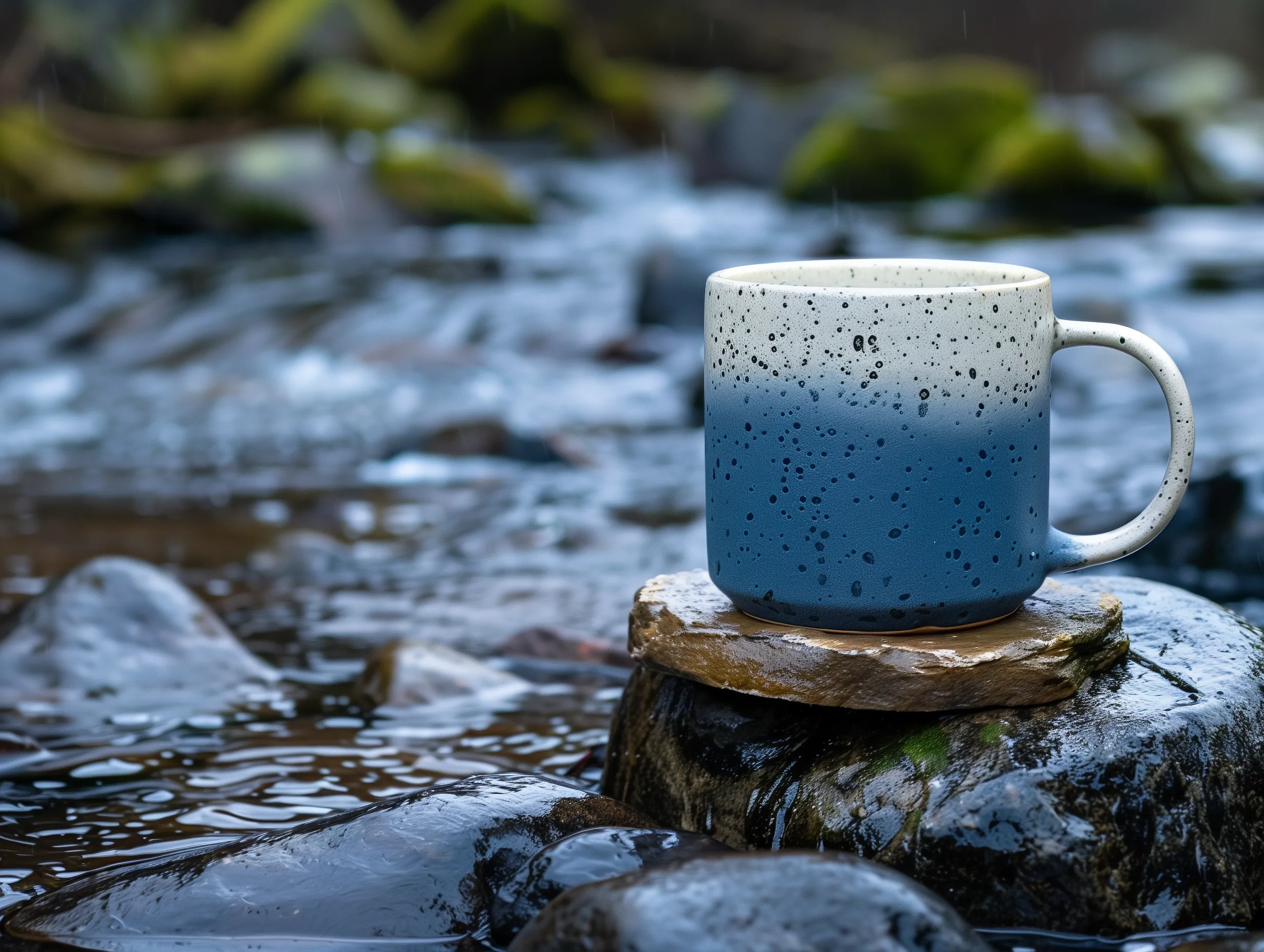
In the Highlands, time moves differently. Days stretch and fold according to the weather — mist one hour, sunlight the next — and the rhythm of making follows suit. The studio’s windows frame a landscape that is never still, and yet within its shifts, a kind of order emerges.
At Fàilte, the process begins with patience. Clay must rest before it can be shaped, glaze must settle before it can reveal its tone, and the kiln must cool before its secrets can be seen. There is no rushing the cycle; each step insists on its own pace. The studio breathes in rhythm with the material, like the tide responding to the pull of the moon.
The seasons leave their quiet mark. In winter, the air inside the studio is heavy and still — every sound softened by snow outside. Pieces dry slowly, their surfaces gathering subtle textures that could not appear in warmth. In summer, the light shifts high and bright, catching the glaze as it’s poured, turning every surface into a study of reflection.
This rhythm is not just practical — it’s philosophical. To make something by hand is to surrender to time. Modern life often asks for immediacy, but clay refuses it. It cracks if pushed, collapses if hurried. In this resistance lies its wisdom.
Each vessel that leaves the studio carries traces of this passage — a variation in tone, a faint ripple in form, a reminder that stillness and motion coexist. The work is not about achieving perfection but about participating in the slow dialogue between maker, material, and moment.
When a finished piece finds its place in someone’s home, that rhythm continues. It enters another cycle — a morning cup filled, a vase refreshed, a bowl emptied and washed — small gestures that echo the same patience that shaped it.
To live with handmade objects is to remember that beauty takes time.
In the Highlands, time moves differently. Days stretch and fold according to the weather — mist one hour, sunlight the next — and the rhythm of making follows suit. The studio’s windows frame a landscape that is never still, and yet within its shifts, a kind of order emerges.
At Fàilte, the process begins with patience. Clay must rest before it can be shaped, glaze must settle before it can reveal its tone, and the kiln must cool before its secrets can be seen. There is no rushing the cycle; each step insists on its own pace. The studio breathes in rhythm with the material, like the tide responding to the pull of the moon.
The seasons leave their quiet mark. In winter, the air inside the studio is heavy and still — every sound softened by snow outside. Pieces dry slowly, their surfaces gathering subtle textures that could not appear in warmth. In summer, the light shifts high and bright, catching the glaze as it’s poured, turning every surface into a study of reflection.
This rhythm is not just practical — it’s philosophical. To make something by hand is to surrender to time. Modern life often asks for immediacy, but clay refuses it. It cracks if pushed, collapses if hurried. In this resistance lies its wisdom.
Each vessel that leaves the studio carries traces of this passage — a variation in tone, a faint ripple in form, a reminder that stillness and motion coexist. The work is not about achieving perfection but about participating in the slow dialogue between maker, material, and moment.
When a finished piece finds its place in someone’s home, that rhythm continues. It enters another cycle — a morning cup filled, a vase refreshed, a bowl emptied and washed — small gestures that echo the same patience that shaped it.
To live with handmade objects is to remember that beauty takes time.
In the Highlands, time moves differently. Days stretch and fold according to the weather — mist one hour, sunlight the next — and the rhythm of making follows suit. The studio’s windows frame a landscape that is never still, and yet within its shifts, a kind of order emerges.
At Fàilte, the process begins with patience. Clay must rest before it can be shaped, glaze must settle before it can reveal its tone, and the kiln must cool before its secrets can be seen. There is no rushing the cycle; each step insists on its own pace. The studio breathes in rhythm with the material, like the tide responding to the pull of the moon.
The seasons leave their quiet mark. In winter, the air inside the studio is heavy and still — every sound softened by snow outside. Pieces dry slowly, their surfaces gathering subtle textures that could not appear in warmth. In summer, the light shifts high and bright, catching the glaze as it’s poured, turning every surface into a study of reflection.
This rhythm is not just practical — it’s philosophical. To make something by hand is to surrender to time. Modern life often asks for immediacy, but clay refuses it. It cracks if pushed, collapses if hurried. In this resistance lies its wisdom.
Each vessel that leaves the studio carries traces of this passage — a variation in tone, a faint ripple in form, a reminder that stillness and motion coexist. The work is not about achieving perfection but about participating in the slow dialogue between maker, material, and moment.
When a finished piece finds its place in someone’s home, that rhythm continues. It enters another cycle — a morning cup filled, a vase refreshed, a bowl emptied and washed — small gestures that echo the same patience that shaped it.
To live with handmade objects is to remember that beauty takes time.